Andrea Kimi Antonelli explains Mercedes porpoising fix in plain terms
Mercedes driver Andrea Kimi Antonelli navigates the 2026 season with eight wins while the team addresses car stiffness issues. The article explores the physics of porpoising, Mercedes aero design, and the championship battle against George Russell.

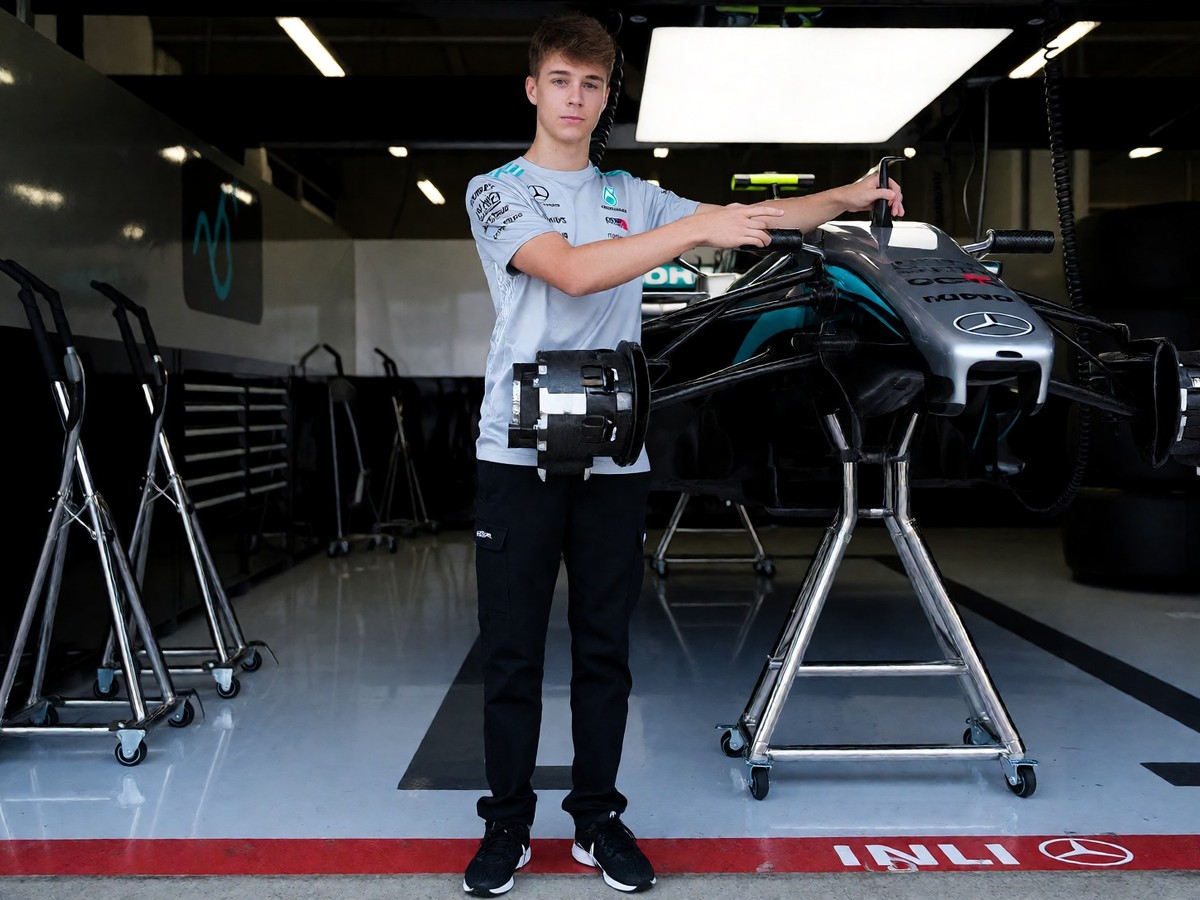
Andrea Kimi Antonelli won eight races out of the first fourteen of the 2026 season. This performance puts him at the top of the drivers’ standings. His victories include a win in China from pole position, a win in Spain, a win in Monaco, and a victory in Monza where he started from 19th on the grid. He also won in Miami and took a victory in the Hungarian Sprint race. These successes follow a rookie season in 2025 that included a Sprint pole in Miami and a podium in Montreal. He also achieved a P2 in Sao Paulo and a top-three finish in Las Vegas during his first year.
Physics behind the bouncing
Porpoising occurs when a car loses downforce at a specific ride height. This loss in downforce causes the suspension springs to return the car to a higher position. Once at that higher position, the flow field generates additional downforce. This restarts the cycle of bouncing. This phenomenon involves an oscillation in the front, the rear, or both. The movement resembles a dolphin coming out of the water nose-up and dipping back under with the nose down. You probably know the basics of ground effect, but the nuance of ride height sensitivity dictates the race.
The Bernoulli principle explains how pressure changes during this process. As a car moves closer to the ground, the cross sectional area for air passing between the car and the ground shrinks. This causes the air to accelerate. Because the air moves faster, the pressure under the car drops while the pressure on top remains unaffected. This creates a net downward force. Viscosity also contributes to this performance. The boundary layer between the two surfaces works to slow the air. In the reference frame of the car, the ground moves backward. This movement pulls on the air and increases the downforce. This is an example of Couette flow.
Engineers use aero maps to manage these sensitivities. An aero map is a 3D graph that visualizes aerodynamic behavior. It plots ride and pitch sensitivities against front and rear ride heights. A single value for downforce is not useful because downforce changes across speed ranges. If the underside of the car contacts the ground, the flow is constricted too much. This results in a near total loss of ground effect. This can cause a car to lose traction and skid off the track.
Mercedes aero design choices
The 2026 regulations include inwashing boards at the front corners of the floor beneath the sidepods. These boards aim to limit outwash around the car to make the wake cleaner for the following vehicle. Most teams try to subvert this intent to gain performance. Mercedes uses a wide sidepod top to create a large undercut. This undercut runs the entire length of the sidepod. The design leaves a wide channel to feed airflow inside the rear wheel.
The W17 also has a high nose. The nose mounts to the middle element of the wing rather than the conventional bottom element. This allows the nose to stop earlier and leaves more space beneath it. This extra volume feeds the underfloor. This differs from the McLaren design, which uses an aggressive front wing and endplate to create spinning vortices. Red Bull’s RB22 also has a wider nose than the Mercedes or Ferrari. This design pushes a high-pressure region outward behind the front wheels. This helps the air stay outward.
| Driver | 2026 Race Wins | 2026 Race Starts |
|---|---|---|
| Kimi Antonelli | 8 | 14 |
| Driver | 2026 Points (after Britain) |
|---|---|
| Kimi Antonelli | Leader |
| George Russell | -25 |
The stiffness problem
Toto Wolff says the team solved the aerodynamic movement of the car around Barcelona. He says the team dissected the problem. Now the issue is the stiffness of the cars. The cars are very stiff. This stiffness causes issues when the cars hit kerbs or bumps. The cars bounce off the kerbs in a hard way. Drivers have complained about the ride. The cars move up and down as load increases on the straight.
The team must find a way to reduce the impact of this stiffness. This is necessary to unlock more performance at a wider range of ride heights. Mercedes needs to find more downforce while running the car at a height that is not as low as they expected. The team is working to find the balance between aerodynamic force and suspension interaction. How much of the current hierarchy depends on the driver’s ability to handle a stiff car?
Driver maturity and routines
Antonelli is 19 years old. He bypassed F3 to spend one year in F2 before joining Mercedes. He joined the team after Lewis Hamilton left for Ferrari. He worked with a psychologist during the winter break to set goals for his sophomore season. He used the break to reflect on the 2025 season. He looked at what went well and what went wrong. He also works on cardio to help in hotter races. He wants to be at 100% energy.
He also spends time with his family to recharge. He says he is more prepared for 2026 than he was in 2025. He follows a routine to stay consistent. He focuses on the process and does his best every day. He wants to grow as a person. He also manages the pressure of being a Mercedes driver. The team tries to protect him from marketing and PR work. He says he has stepped up this year. He says he has found a way to be consistent.
Russell tries different settings
George Russell had a difficult weekend at the Miami International Autodrome. He struggled to find a rhythm because the track layout did not suit his driving style. He finished fourth in the race after a late recovery. He was in sixth with 20 laps to go. He was a step behind Antonelli for most of the weekend. To improve, he made big changes to his car. He adjusted his differential and his brake bias.
He set these to be much closer to the settings Antonelli used all weekend. These changes had a larger impact than he expected. Russell trails Antonelli by 20 points after the first four rounds. Russell is 28 years old. He praised Antonelli as a fantastic driver. He said Antonelli is exceptionally quick. He has confidence in himself. He noted that the Miami circuit is always a tough one for him.
Reliability and penalties
Reliability issues affected the Mercedes drivers in multiple races. In the 2026 Australian Grand Prix qualifying, Mercedes paid a €7,500 fine. A cooling fan part from Antonelli’s W17 flew off. One piece fell in the Turn 1 braking zone. Another part came off near Turn 3. Lando Norris ran over the piece. The stewards said the car left the garage in an unsafe condition.
In Britain, a different reliability issue struck. A component called the wheel shield, which is part of the front brake duct, failed. The part became loose and interacted with the steering and the suspension. This made the car very lazy and almost undriveable. Antonelli had to enter the pits twice. He finished the race in P16. The FIA also gave him a five-second penalty for track limits. This happened after he was running in P2. He was bumped up to P15 after a penalty for Carlos Sainz.
The championship battle
The championship fight is between Antonelli and Russell. Antonelli leads Russell by 25 points after the British Grand Prix. Antonelli won the Sprint in Hungary. Russell took P2 in the British Grand Prix. Mercedes won in China with a one-two finish. Antonelli won from pole position. Russell was second. Hamilton was third for Ferrari. Ferrari is becoming a rival. Hamilton made an excellent start in China. Leclerc finished fourth. The 2026 season is still in its early stages. Mercedes shows strength in speed and reliability.