Risks in Mercedes’s 2026 front wing load test interpretation loophole
Mercedes faces potential disqualification and the loss of 43 championship points if the FIA rules their two-phase front wing movement is an intentional exploit. The team claims the aerodynamic behavior resulted from a hydraulic miscalculation rather than a regulatory breach.

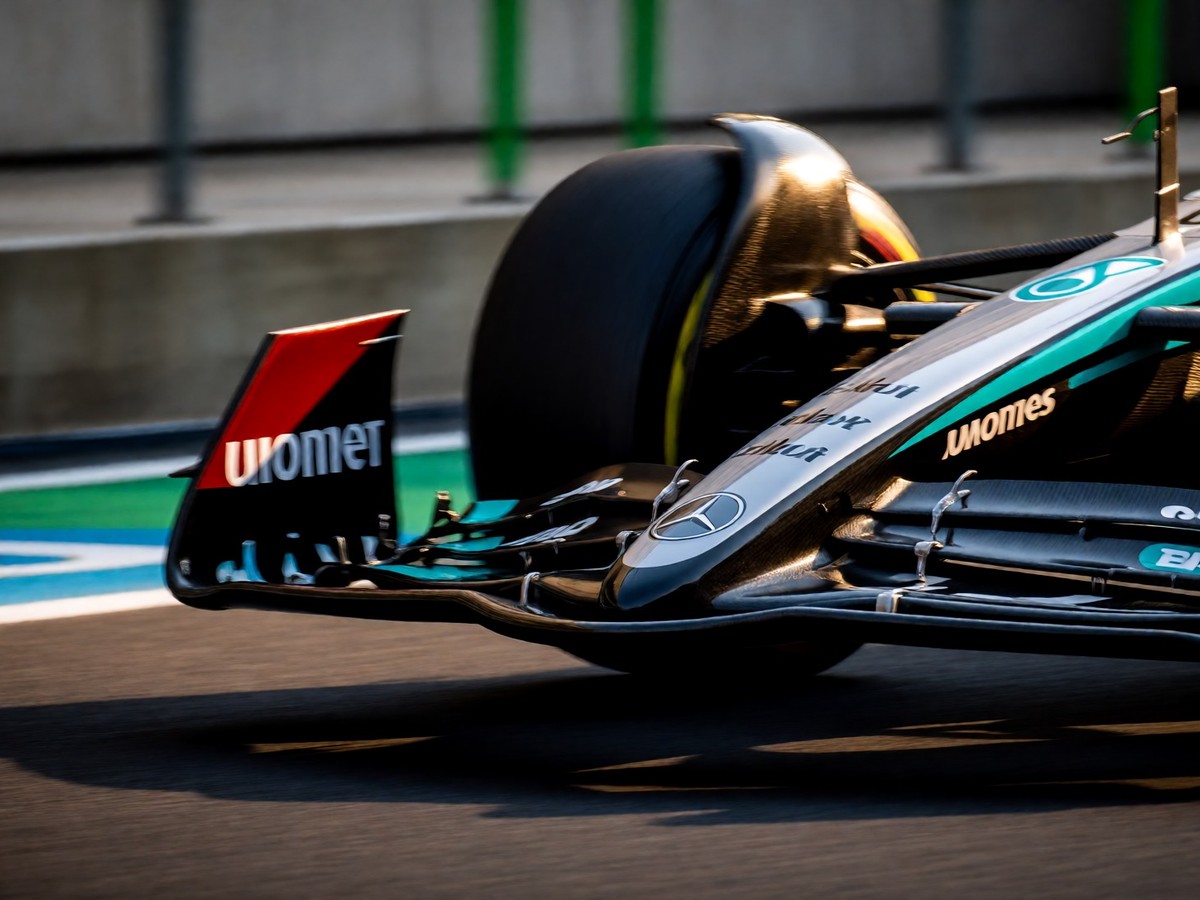
I believe the Mercedes two-phase wing situation presents a massive risk to their 2026 campaign if the FIA decides the movement was intentional. The investigation into the W17 front wing targets a specific method of active aerodynamics that could fundamentally change the competitive balance of the grid.
The two-phase movement mechanism
The Mercedes W17 utilizes an active aerodynamics system that appears to operate in two distinct stages rather than a single, continuous motion. According to Article 3.10.10 of the technical regulations, the transition time between the two fixed states of the front and rear wings cannot exceed 0.4 seconds. Mercedes allegedly uses a two-phase closing mechanism to satisfy this rule while still gaining an aerodynamic advantage. The wing snaps partially shut within the 400-millisecond window to satisfy the position sensors connected to the FIA Standard ECU. After this initial movement, the wing then continues to settle into its final position over an additional 800 milliseconds.
This two-stage process could allow the team to manipulate the aerodynamic center of pressure. By having a slower, second stage of movement, the team can control how the downforce bleeds away as the car approaches a corner. This could lead to a more progressive transition for the car’s dive under braking, which would reduce plank wear and allow for a lower front ride height. It also provides the sensation of greater stability to the drivers. Kimi Antonelli and George Russell would find the car easier to handle in heavy braking zones if they could avoid sudden, snappy weight transfers.
Theoretically, this method also assists with energy harvesting. A slower reduction in front downforce could move the center of pressure towards the rear more effectively. This shift helps the car manage the transition from high-speed running to corner entry. Data from the first two races shows the Mercedes harvests energy more quickly than the identically engiced McLaren. This suggests the wing behavior might assist with the aggressive energy harvesting required for the 2026 power unit regulations.
The hydraulic miscalculation defense
Mercedes claims the strange behavior in Shanghai resulted from a technical error rather than a deliberate attempt to exploit a loophole. The team argues that the wing’s slower return to corner mode was a mistake caused by insufficient hydraulic pressure. During high-speed runs, the aerodynamic forces pushing against the wing were too high for the current hydraulic system to overcome instantly. The wing could not reach its final fixed position until the car slowed down and the aerodynamic loads decreased.
Mercedes first noticed this problem during qualifying in China. The team changed the front wing for George Russell during that session to address the inconsistency. Engineers at the Brackley factory have since worked to improve the hydraulic actuators to make the system more reliable. The team believes that the failure to meet the 400-millisecond window at high speeds was a miscalculation of the forces required to switch wing modes.
The FIA has discussed this situation with Mercedes and remains satisfied with the explanation provided by the team. The governing body notes that the team’s effort to fix the system suggests there was no nefarious intent. However, rival teams remain skeptical of this explanation. They argue that a team with the engineering resources of Mercedes would not make such a basic miscalculation of hydraulic requirements.
The risk of technical directives and disqualification
If the FIA decides the two-phase mechanism violates the intent of the active aero regulations, the governing body will issue a Technical Directive. A Technical Directive is a tool the FIA uses to close a loophole by clarifying how a rule will be enforced. If a directive is issued before the Japanese Grand Prix, Mercedes must physically alter their hydraulic actuators or remap their software. This would force the wing to fully close within the strict 400-millisecond window. Such a change would disrupt the aerodynamic balance the team has developed for the W17. Without the delayed reduction in front downforce, the drivers would have to adjust their braking markers and manage increased front tire wear.
The situation becomes much more severe if the FIA classifies the mechanism as a direct breach of the technical regulations. If the governing body decides the device was designed to cheat the Standard ECU sensors, the penalties become retrospective. Mercedes could face disqualification from the Chinese Grand Prix. This would result in the loss of 43 World Championship points from their 1-2 finish. Such a penalty would deal a devastating blow to the team’s title hopes.
You already know that F1 history is full of teams pushing the limits of what the wording of a regulation allows. Mercedes will likely argue that they followed the exact letter of the law. Clause (q)(iii) of the regulations states that movement must be measured by position sensors. If the Mercedes sensors reported a successful closure within 400ms, the team will maintain they complied with the regulations.
| Test Condition | Original 2025 Limit | New 2025 Limit (from Spain) |
|---|---|---|
| Symmetric Load (100kg) | 15mm | 10mm |
| Asymmetric Load (100kg) | 15mm | 10mm |
| Asymmetric Load (100kg) | 20mm | 15mm |
| Flap Trailing Edge (6kg) | 5mm | 3mm |
Rival scrutiny and the flexibility debate
Red Bull and Ferrari have expressed significant concerns regarding the flexibility of the front wings used by Mercedes and McLaren. Helmut Marko noted that television images from Montreal showed the wings of George Russell and Lewis Hamilton bending noticeably. Red Bull has asked the FIA to take a closer look at how the Mercedes front wing flexes at speed. While the wings passed the initial strength tests during approval, the competition remains critical of the aeroelasticity.
The FIA has already moved to tighten the rules regarding bodywork flexibility. Following analysis of the 2024 season, the FIA introduced more stringent static load tests. These changes aim to ensure that teams cannot use wing deformation to reduce drag at high speeds. The level of permitted vertical deflection for symmetric loading has dropped from 15mm to 10mm. For asymmetric loading, the limit moved from 20mm to 15mm. The permitted deflection for the trailing edge of the front wing flap also dropped from 5mm to 3mm when a 6kg load is applied.
Red Bull has sought support from other teams, including Aston Martin, to address these concerns. Christian Horner has stated that the team will protest if they believe a competitor is not in compliance with the rules. There is currently no proof that Mercedes or McLaren is doing anything wrong, but the high stakes of the championship drive rivals to monitor every movement.
The nose pylon design differences
Mercedes and Aston Martin have adopted a different front wing configuration compared to the rest of the grid. Most teams, such as McLaren, mount the nose to the main element of the front wing. This allows the second and third elements to flatten on the straights as the regulations permit. Mercedes and Aston Martin, however, attached their nose pylons to the second element.
This design choice carries specific trade-offs. By attaching the nose to the second element, these teams sacrifice some of the movement freedom allowed by the regulations. However, this configuration allows the structural part of the nose to be shorter. A shorter nose structure can influence how air travels toward the floor. It also provides more design freedom for the main plane of the wing.
The Mercedes W17 also includes a small opening in the nose located between the Akkodis and SAP logos. This hole provides access to a flap adjustment mechanism during pitstops. This allows for adjustments to happen on both sides of the car. This differs from older methods where both sides had to be adjusted manually on the outboard part of the wing. Red Bull and McLaren also have similar holes, while the Ferrari SF-26 does not show this feature.
Historical precedent for engineering loopholes
Formula 1 has frequently seen teams exploit gray areas in the technical regulations. In 2020, Mercedes introduced Dual-Axis Steering, which allowed drivers to change the toe angle of the front tires by pulling the steering wheel. The rules stated that suspension could not be adjusted while moving, but they did not classify steering as suspension. The FIA allowed the system to remain legal for the entire season before banning it the following year.
McLaren exploited a loophole in 2010 using the F-Duct. Drivers used their hands or knees to cover a hole in the cockpit, which routed air to stall the rear wing. This bypassed the ban on moveable aerodynamic parts because the driver’s body was the moving component. This discovery directly inspired the development of the DRS system.
Brawn GP provided another example in 2009 when they utilized a double diffuser. The team exploited the dimensional limits of the floor regulations to increase downforce. Although rival teams protested, the FIA ruled that the interpretation of the wording was technically correct. This loophole helped Jenson Button win the World Championship.
Engineering competition and the FIA role
The competition between the 11 teams involves a constant struggle to find performance within the margins of the rules. Ferrari team principal Fred Vasseur has noted that it is a massive challenge for the FIA to prevent teams from exploiting loopholes. He stated that if a team finds a way to build a faster car through a loophole, it is a challenge for the governing body. He described the situation as dangerous for the sport if one team pulls away due to an undetected development route.
The FIA attempts to manage this through regular inspections and technical updates. They use high-resolution cameras and tracking dots to monitor car behavior. They also conduct static load tests in parc ferme conditions to ensure teams are not using different components for qualifying and racing.
Will the FIA accept the hydraulic miscalculation as a legitimate technical error or will they pursue the legality of the two-phase movement?