FIA battery thermal runaway containment protocols
FIA safety protocols for the BSR Electric Karting Championship mandate specific CO2 extinguishers and fiberglass blankets for garage protection. These measures follow investigations into the Valencia battery fire involving a DS Penske car to prevent thermal runaway propagation.

Paddock Equipment and Deployment
BSR Electric Karting Championship protocols mandate specific equipment for every team to control electrical and battery-related fire hazards. Each team tent for every two karts requires one 3 – 5 kg CO2 extinguisher and one 1×1 m fiberglass fire blanket. Teams must place one extinguisher and one blanket every 200 to 300 meters to ensure full coverage of the risk area. Fire blankets must remain clean, intact, and accessible to all personnel. All extinguishers must have valid inspection tags and clear expiration dates to remain in service.
Charging areas must remain clear of spectators and unnecessary equipment to minimize risk. Access to the Battery Charging Zone (BCZ) remains limited to trained team personnel and officials. Racing teams must disconnect all charging systems immediately if they detect fire, overheating, or smoke. You already understand the basic risks of lithium-ion fires, so focus on the specific containment technologies used in professional racing garages.
| Equipment Type | Specification/Requirement | Placement/Maintenance |
|---|---|---|
| CO2 Extinguisher | 3 – 5 kg | 1 per tent (per 2 karts) |
| Fire Blanket | 1×1 m fiberglass | 1 per tent (per 2 karts) |
| Extinguisher Spacing | N/A | Every 200 – 300 meters |
| Charging Voltage | 110 – 250 VAC | BCZ access restricted |
| Kart Voltage | 48 – 96 VDC | Low voltage handling |
The Valencia Incident
The FIA investigation into the Valencia battery fire at Circuit Ricardo Tormo provides specific safety benchmarks for garage management. The event involved a DS Penske car, driven by Robert Shwartzman, which triggered its automatic battery safety system during a three-hour session. The system produced a red light signal, forcing the car to stop on track before it returned to the pits. During a manual inspection by the battery supplier team, an arc flash and sparking caused a localized fire. The FIA investigation revealed that manual inspection of the battery caused an arc flash and sparking that resulted in a localized fire, which damaged the WAE and Mahindra garages.
The fire forced Mahindra to run only one car for the remainder of the test after the blaze hit the garages. The FIA confirmed that all the batteries used by teams had been checked and that none of the batteries present the same type of symptoms as the unit that failed during the Valencia test. To mitigate risks, the FIA introduced a series of additional safety measures including reducing the power output to 300kW and investigating with immediate effect any potential issue or similar occurrence.
Cell-Level Reactive Coatings
The electrochemical interface requires immediate protection to prevent thermal runaway. Thermally cross-linking SEI films deposit a nitrogen-containing polymer onto active-material powder before calendaring. When cell temperatures reach the 80 to 280 °C window, pendant groups cross-link to stiffen the film. This process throttles lithium-ion transport and pins reactive oxygen in the cathode lattice. This autonomous current-interruption mechanism requires no external circuitry.
Dendrite-blocking layers offer additional protection for the electrode. These layers consist of a solid or gel electrolyte rich in ceramic ion conductors. This layer allows lithium-ions to travel freely while arresting sharp metallic dendrites. Testing shows these layers sustain over-charge conditions of 1.5C for 30 minutes without internal short formation. Control cells puncture the separator within 8 minutes.
In-cavity gas-phase coating processes address latent defects like internal metal burrs or weld spatter. This process uses alternating sub-kPa pulses of organometallic precursors and oxidants to create conformal films across foil edges, vent components, and tab welds. An optional on-board laser flash densifies the coating in milliseconds. This densification generates graded compositions that protect against corrosion and preserve electrolyte wettability.
Advanced Separator and PCM Technologies
Designers use various methods to manage heat at the cell level. A conformal ALD alumina coating grows an A-level layer of Al2O3 across both faces and down each internal pore wall of the separator. This coating doubles mechanical puncture strength and extends dimensional stability 70 to 100 °C beyond the polymer melt point. Particle-bonded high-temperature separators use nano-scale to micro-scale ceramic particles packed into a self-supporting mat. This melt-free skeleton maintains porosity above 65 percent even when the membrane exceeds 200 °C.
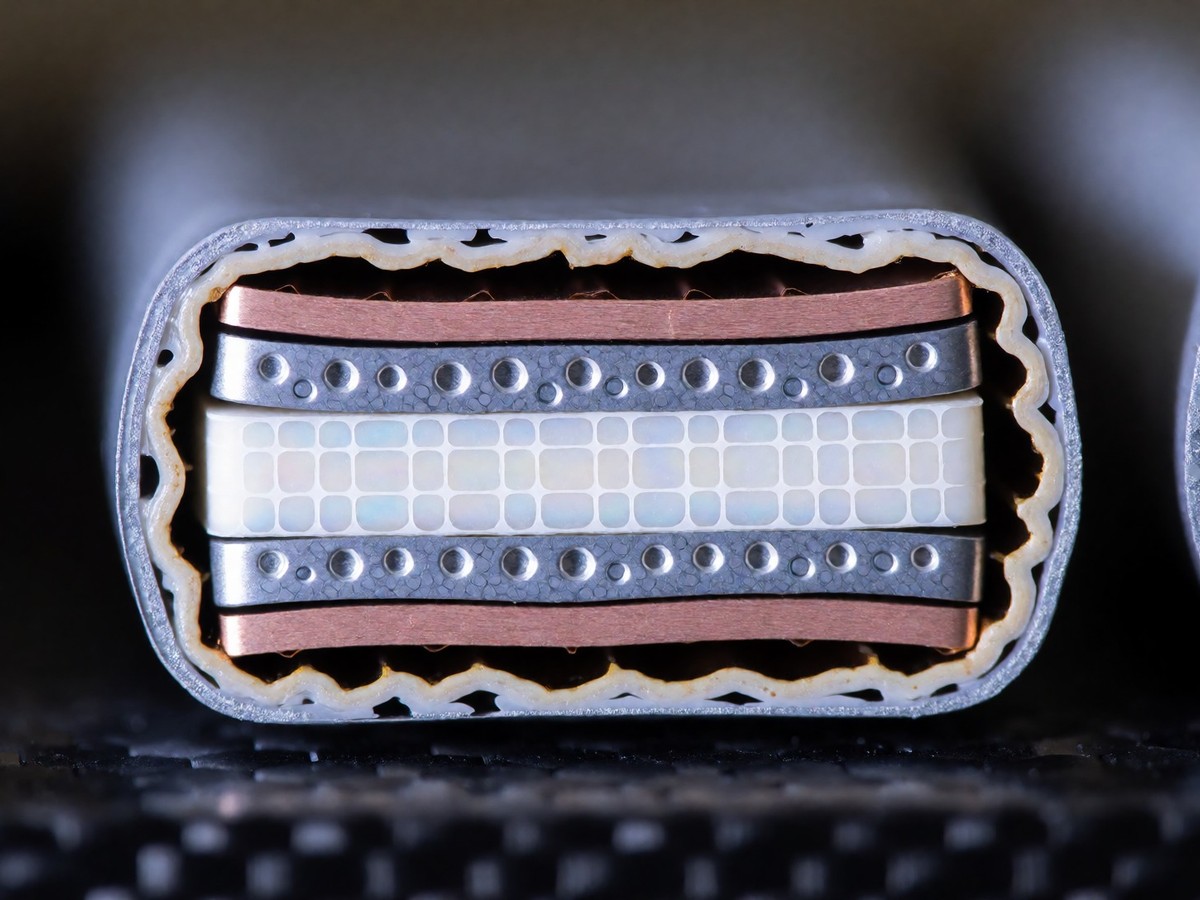
Phase-change materials (PCM) provide a macro-scale thermal layer outside the separator. PCM sleeves use a silicone matrix containing micron-scale paraffin reservoirs to soak up 60 to 80 kJ per litre before temperatures climb more than 10 °C. For prismatic pouch cells, this can suppress capacity fade by 15 percent over 1,500 fast-charge events. Double-bent seal PCM inserts place a slim ribbon in the pouch perimeter to provide 12 to 16 °C of peak temperature suppression during a 3C discharge. Micro-encapsulated PCM coatings spray a silica shell around droplets to ensure no free liquid exists at any state-of-charge.
Module-Level Fillers and Barriers
Module-level fillers manage the empty spaces between cells to prevent the spread of heat. Silicone syntactic foam with hollow borosilicate microspheres fills these cavities with a density of 0.3 to 0.5 g/cm3. This foam blocks an 850 °C flame for 4 minutes, which gives the battery management system time to isolate the failing string. The material provides vibration damping and cushions cell swell.
Intumescent and endothermic barriers provide a dynamic defense against flame. A multifunctional ceramic-endothermic blanket mixes aluminium trihydrate or hydromagnesite with silica fibres. When temperatures hit 200 to 250 °C, these fillers decompose to absorb up to 1,200 J/g and release water vapour or CO2. This process dilutes combustible electrolytes and delays flame penetration by 11 minutes. Silicone-to-ceramic wraps provide another layer of protection. Once temperatures reach 350 °C, the wrap sinters into a rigid ceramic wall. This action cuts the heat transfer rate by 75 percent within 90 seconds.
Bifunctional SiO2 foam fillers provide a final safeguard in densely packed modules. The silica matrix conducts heat to the cold plate below 130 °C. Above this threshold, embedded foaming agents inflate the filler to five times its original volume to isolate the failing cell. Self-gapping hybrid housings use a bonded metal skin that delaminates under extreme heat. This delamination creates an air gap that throttles heat penetration while the composite frame carries crash loads.
Clean Agent Fire Suppression
Clean agent fire suppression systems provide a safe alternative to water for sensitive electronics. Water-based suppression ruins electronics, whereas clean agents like Novec 1230 and FM-200 provide non-conductive, gaseous extinguishing agents. These agents leave no residue upon evaporation. Novec 1230 provides a lower Global Warming Potential (GWP) than FM-200. Both agents have a zero Ozone Depletion Potential (ODP).
These systems respond swiftly, reaching concentration levels in under ten seconds. NFPA 2001 guidelines govern the design and installation of these systems to protect valuable equipment without collateral damage. Clean agents are ideal for data centers, laboratories, and museums where water would cause significant property damage.
Maintenance of these systems requires strict adherence to inspection protocols. Building owners must verify the weight of clean agent cylinders. For CO2 systems, owners must conduct a 12-year hydrostatic test if the cylinders have never been emptied. Maintenance also includes testing control panel equipment and conducting room integrity testing.
Certification and Propagation Risks
Safety standards like UL 9540 establish system-level requirements for battery energy storage. However, a gap exists between minimum compliance and real-world safety. Certification sets a baseline for performance under controlled conditions, but it does not account for the simultaneous stresses a system faces during operation. The primary risk in scaling battery systems involves propagation, where a failure in one cell spreads to neighboring cells.
UL 9540A provides a methodology for evaluating this thermal runaway propagation. While many technologies rely on pack-level protections to meet these standards, cell-level validation under UL 9540A is uncommon. Effective safety validation requires tests such as nail penetration and crush testing to simulate mechanical abuse. These tests help engineers understand how a cell enters thermal runaway and how that failure progresses.
Material selection also dictates safety. Chemistries with greater thermal stability reduce the risk of cascading failure. Some manufacturers use a metal-free polymer cathode that evolves carbon dioxide instead of oxygen during decomposition. This characteristic limits combustion intensity compared to conventional oxide-based cathodes.
How will future high-energy density chemistries interact with these current containment methods?
Paddock Management and Maintenance
BSR Electric Karting Championship protocols define clear responsibilities for the Fire Marshal. The Fire Marshal oversees fire safety readiness across the paddock and track. This person coordinates with the Race Director and ensures every tent has the required extinguishers and blankets. The Fire Marshal also performs pre-event fire safety inspections and orders corrections for missing or expired equipment.
Risk-based escalation determines the response to a thermal event. If a fire involves rapidly spreading flames, injuries, or multiple batteries, the situation is high-risk. In high-risk situations, the nearest responsible person applies CO2 or a fire blanket, and the Fire Marshal must call emergency fire services immediately. The Fire Marshal then communicates the hazard location and type and orders the evacuation of nearby personnel.
Medium or low-risk situations allow for local control. If the fire is limited to a 3 m radius and involves no injuries, the local responsible person can control the fire using CO2 and blankets. The Fire Marshal performs a post-incident inspection after the suppression is complete. All fire-related events require documentation. The Fire Marshal records the time, location, cause, and action taken in an incident note. The BSR Race Director files this report to improve future prevention.