McLaren abandons experimental rear wing hinge geometry
Technical director Neil Houldey abandoned an experimental three-link rear wing hinge during the Austrian Grand Prix after it failed to provide necessary stability. The design aimed to reduce drag by keeping wing tips close to the endplates, providing 400-600 kg of downforce.

Neil Houldey, the technical director for engineering at McLaren, abandoned the experimental rear wing during the Friday practice sessions at the Austrian Grand Prix. The team encountered problems during final sign-off tests in the garage. Once the team actuated the component, the engineers realized it did not perform as expected. The team decided to focus track time on the optimization of the current aerodynamic package rather than troubleshooting the experimental part. The revised wing returned to the factory for further refinement after the team realized the component would not provide the necessary stability during the sessions.
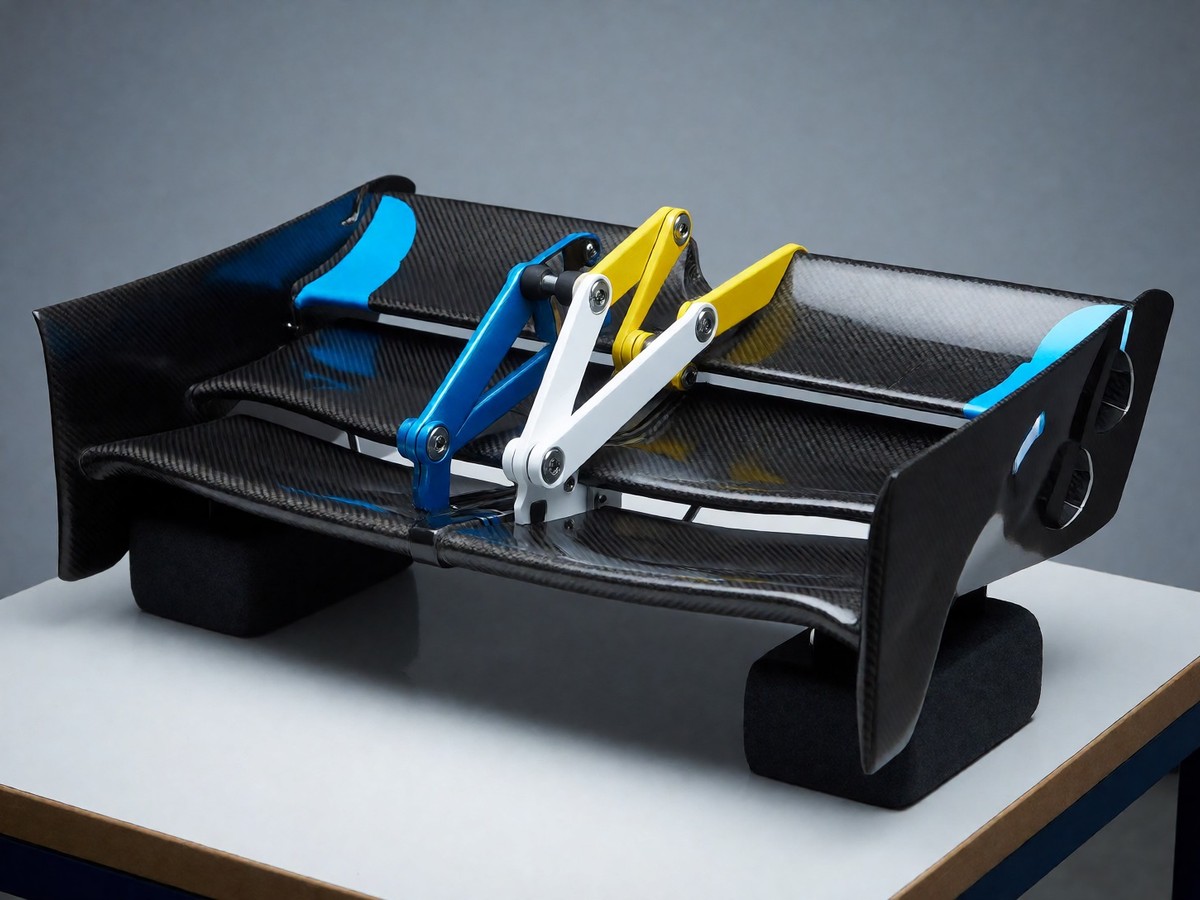
The decision to pull the experimental rear wing from the track at the Red Bull Ring allowed the engineers to prioritize the optimization of the existing aerodynamic package for the upcoming qualifying sessions. This development concerns the hinge geometry of the pivoting rear wing, a design that utilizes a three-link mechanism to move the flaps. The design differs from the Ferrari approach, which integrates the actuator into the endplate. It also differs from the Red Bull version, which uses a metal structure to house the actuator. McLaren uses a centrally mounted actuator that drives three interconnected links joined by pivot pins.
The movement of the hinge geometry follows a specific kinematic sequence. The kinematics begin when the actuator piston extends. This movement pushes the first link, which the team colors blue, to an angle of approximately 45 degrees. The second link, which is white, then shifts into an almost horizontal position. Following this, the third link, colored yellow, rotates until it reaches an angle close to 90 degrees relative to the second link. Because the yellow link connects to the lower of the two movable flaps, it provides the physical lift and support for the flaps as they deploy.
The lateral pivot points of the McLaren design remain conventional. The engineers positioned two free-moving pivot elements at the ends of the upper flap. These elements allow the movable wing elements to rotate while following the movement of the hydraulic actuator. This design keeps the wing tips very close to the endplates. This proximity limits the formation of turbulence that typically increases when the outer sections of the wing become exposed. Red Bull uses a different solution with a complex system of lateral pivots that rotate during deployment. In that design, the outer edge of the wing lifts when the component opens.
The three-link arrangement provides a weight advantage over the competition. The links themselves act as the load-bearing structure for the assembly. This approach avoids the need for a rigid cage to house the mechanism, which the Red Bull design requires. This difference in hinge geometry affects how the car manages airflow at high speeds.
The aerodynamic performance of the MCL40 depends on the efficiency of these rear wing components. The rear wing provides 400-600 kg of downforce with a lift coefficient of 1.8 and an area of 0.8 m2. The team must manage the relationship between downforce and drag to maintain straight-line pace. The DRS rules mandate specific constraints on the movement of the flaps. The slot gap between the flaps must measure between 9.4 mm and 13 mm when the wing stays closed. The maximum opening for the DRS is 85 mm. The transition from closed to open must happen in under 400 ms.
| Component | Specification Value |
|---|---|
| Rear Wing Downforce | 400-600 kg |
| Rear Wing Lift Coefficient (Cl) | 1.8 |
| Rear Wing Area | 0.8 m2 |
| DRS Closed Slot Gap | 9.4-13 mm |
| DRS Maximum Opening | 85 mm |
| DRS Transition Time | < 400 ms |
The engineering team also updated the rear brake duct inlet during the same period. The engineers reshaped the geometry of the inlet to improve local flow conditioning around the rear corner of the car. This change helps stabilize the wake structures that influence both the rear-tyre performance and the efficiency of the diffuser. By refining how air flows into the assembly, the team aims to improve the aerodynamic load generated in that region.
You already understand the difference between a high-downforce and low-downforce setup, so the necessity of minimizing turbulence at the rear wing tips becomes clear. The team’s goal with the three-link hinge geometry was to reduce the drag caused by the wing’s outer corners. Red Bull’s design causes the outer edge to lift, which can increase turbulence. McLaren’s version keeps the wing tips close to the endplates to prevent this. The failure in the garage during the Austrian Grand Prix indicates that the movement of the links did not produce the intended aerodynamic effect.
The development of this hinge geometry follows a long-term strategy. The team spent two months analyzing the potential of this aerodynamic component. This work follows the work done in Miami, where the team focused on sidepods, the underbody, and the front wing. The Woking-based team views the pivoting wing as an experimental prototype for data collection. The final version of the wing is expected to arrive in the second half of the season.
The front wing also underwent changes in the development package. The profiles of the upper elements follow a new trend to direct flow toward the rest of the single-seater. On this version, the mobile flaps extend to the endplate bulkheads. This change maximizes the reduction of straight-line resistance. The team tested this innovation during a free practice session but found the performance fell below expectations.
The rear wing’s performance impacts the entire aerodynamic balance of the MCL40. The rear wing adds 400-600 kg of downforce, while the front wing delivers 200-300 kg. The floor provides 500-800 kg from Venturi channels. If the hinge geometry of the rear wing fails to provide the expected reduction in drag, the balance between the front and rear of the car shifts. A 2-mm shift in a flap can move 20 kg of downforce, which affects handling precision.
The team remains focused on the development of the MCL40 for future races. The experimental wing will undergo more work in the factory before it returns to the track. The team will prioritize the current aerodynamic package for the upcoming races in the season. Will the development team successfully refine the three-link kinematic arrangement to allow for a more stable deployment at the next race?