Lando Norris debunks McLaren 2026 pit stop release myths
Andrea Stella explains that McLaren's pit stop delays stem from hardware complexity rather than crew error. The team is targeting equipment fixes for 2026 to improve performance after a 3.88 second average stop time in recent races.

Pit lane performance and the speed gap
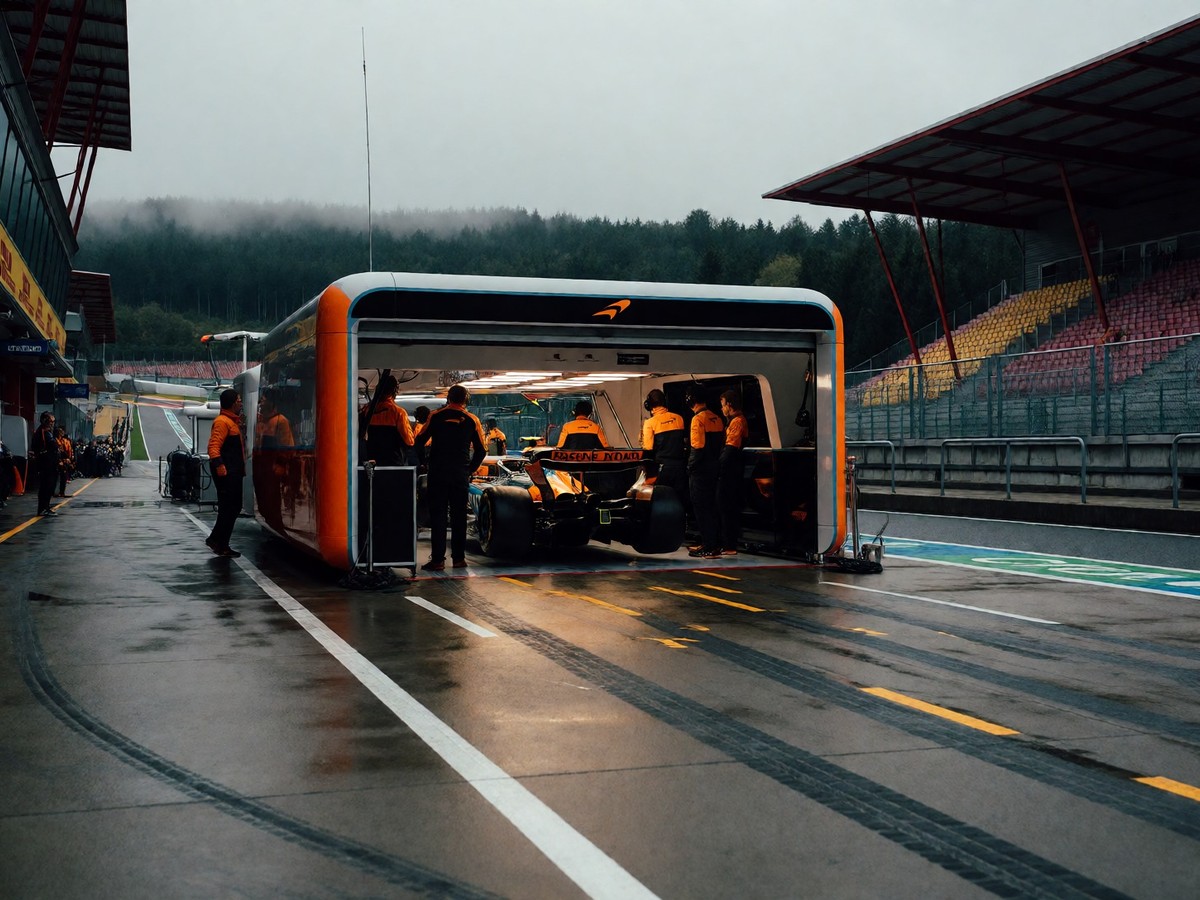
McLaren’s pit crew averages 3.88 seconds per stop over the last six Grand Prix events. This performance lags behind Mercedes, which maintains an average of 2.56 seconds. In Madrid, a 6.65-second stop cost Lando Norris second place to Max Verstappen. Lando Norris finished less than one second behind Max Verstappen in Madrid despite facing a pit stop that was 4.31 seconds slower than the time required to maintain his position in the race. Only 3 out of 10 McLaren pit stops were completed in under three seconds. This trend marks a decline for the team, as they ranked as the second-best pit stop squad in 2025, trailing only Ferrari. McLaren currently occupies sixth place in the season’s pit-stop standings, making them the slowest among the top four teams. Andrea Stella says hardware makes the gunning operation more complex than it should be. The team targets hardware fixes for the 2026 season to ensure mechanics can reproduce fast stops more easily.
The concentration of slow stops on Norris in recent weeks is a coincidence of timing. Norris suffered three consecutive pit stops lasting more than four seconds in Zandvoort, Monza, and Baku. In Zandvoort, a 4.83-second stop caused him to lose ground to Piastri before he retired. At Monza, a slow tyre change caused him to lose track position to Piastri. In Baku, a stop exceeding four seconds moved him toward the back of a group of cars. Stella says the data does not support the idea that Norris suffers more pit stop issues than Piastri over the whole season. He says the concentration of slow stops on Norris is a coincidence because of a short observation window. The team notes that the last three races involved one-stop strategies, which makes stop errors more visible.
Debunking the Spa strategy conspiracy
Speculation regarding unfair treatment of Lando Norris at the Belgian Grand Prix focused on radio instructions between laps 11 and 13. The team discussed scenarios where the lead driver would take medium tyres during an inters-to-slicks transition. Oscar Piastri took the mediums as the lead driver, while Norris opted for hard tyres to create an offset strategy. This strategy meant Norris stayed out for an extra lap to take the harder compound. Norris’s decision to delay his stop allowed him to attempt a longer stint, but a technical problem with the rear-left tyre during his Lap 30 stop cost him several seconds. This technical issue resulted in a 7.8-second stop, which relegated him to eighth place. Piastri’s stop was completed in 2.9 seconds on Lap 20.
You know how much a single second in the pit lane can decide a championship battle. Norris’s strategy was a deliberate choice to gain an advantage. He started thirteenth due to a 10-place grid penalty for exceeding the limit of allocated power electronics units. He drove through the field, passing Gabriel Bortoleto on Lap 5, Franco Colapinto on Lap 7, Liam Lawson on Lap 9, and Arvid Lindblad on Lap 12. He inherited the lead when those on Medium tyres entered the pits. He finished seventh after setting 13 fastest laps. He finished 0.7 seconds behind Isack Hadjar. Piastri finished fifth after sustaining bodywork damage following contact with Charles Leclerc. That damage cost him between 0.2 and 0.3 seconds per lap.
Hardware complexity and human error
The claim that Norris’s slow stops result from poor team coordination is a misconception. Stella says the hardware makes the operation of changing tyres less natural and less easy. The team is working with its pit crew to mitigate difficulties introduced by the hardware. This is a matter of equipment rather than a lack of skill from the mechanics. The crew placed second in the 2024 DHL fastest pit stop awards, proving their capability. The current issues in the pit lane stem from the quality of the tools used during the stop.
The team identifies that the gunning process is more complex due to existing equipment. They are applying corrections to the hardware for the 2026 season. While the crew performs the execution, the hardware dictates the ease of the operation. The team aims to improve all factors, from the human element to the mechanical components. This work happens at the factory with the testing rig.
The 2026 active aerodynamics transition
The 2026 technical regulations introduce active aerodynamics to replace the current DRS system. Drivers will switch between Z-mode for high downforce in corners and X-mode for low drag on straights. This system allows both the front and rear wings to rotate between two positions. The cars will be smaller and lighter, which should increase agility. The engines will feature a 50/50 split between the internal combustion engine and electrical power.
Lando Norris says he wants the 2026 cars to remain driver-focused. He expressed concern that the move to active aerodynamics might make racing feel too artificial. He believes the cars will not look as spectacular because they will lose speed at the end of straights. He wants a sense of normality in the car’s performance. Will the active aerodynamics actually improve the quality of overtaking?
| 2026 Regulation Detail | Technical Specification |
|---|---|
| Power Unit Split | 50% Combustion / 50% Electrical |
| Aerodynamic System | Active (Z-mode and X-mode) |
| Minimum Car Weight | 724kg |
| Maximum Width | 190cm |
| Maximum Height | 95cm |
| Maximum Wheelbase | 340cm |
The VSC and Spanish Grand Prix timing
The Virtual Safety Car (VSC) rules at the Spanish Grand Prix led to claims of unfairness from Lando Norris. A VSC was deployed on Lap 15 due to an incident involving Lance Stroll. Norris had just passed the pit entry when the VSC was called, meaning he could not pit without losing significant time. His rivals, including those behind him, were able to pit because they had not yet reached the pit entry. This prevented Norris from taking a cheap pit stop, and he eventually lost 20 seconds of race time. He finished third after recovering from fifth.
Zak Brown says the VSC was cruel because the timing prevented the driver from benefiting. The decision was out of the control of the team and the driver. Norris argued that the rules should ensure everyone has the opportunity to pit. He believes racing should be won by the best performance rather than rules that prevent an equal opportunity for pit stops.
Ferrari and Hamilton pit lane errors
Ferrari has faced multiple issues regarding pit lane safety and execution. During the Belgian Grand Prix, a mechanic was struck by Lewis Hamilton’s car as he was released from his pit stop. The mechanic was looking down at a front wing tool and did not see the green light signal. The stewards fined Ferrari €30,000 for this unsafe release, with €10,000 of that fine being suspended for 12 months. Hamilton had already served a five-second penalty for contact with George Russell before the pit stop occurred.
In the Dutch Grand Prix, Carlos Sainz lost 12.7 seconds when a tyre was not ready during his pit stop. Sergio Perez also ran over a tyre gun that a Ferrari mechanic left on the edge of the pit box. These incidents show that pit lane errors can affect race results across different teams. The team committed to reviewing pit stop procedures to ensure such incidents do not happen again.
Driver development and academy results
The McLaren Driver Development Programme continues to produce results in junior categories. At Paul Ricard, Christian Costoya finished Race 1 in P12 and Race 2 in P7, then took a P3 podium in Race 3. Ella Hakkinen finished P27 in Race 2 and P32 in Race 3 of the same event. Matteo De Palo retired from the FIA Formula 3 race in Spa due to suspension damage after contact on the first lap.
In Indycar, the Arrow McLaren team competes at the Nashville Superspeedway. Pato O’Ward qualified in P12, while Nolan Siegel qualified in P13. Christian Lundgaard qualified in P19 but faces a grid penalty due to an engine issue.
2026 technical specifications and components
The 2026 power units consist of six components. These include the internal combustion engine, the turbocharger, the Motor Generator Unit-Kinetic (MGU-K), the Energy Store (ES), the Control Electronics (CE), and the exhaust. Each driver may use up to four ICEs, four turbochargers, and four exhaust sets. They may use up to three MGU-Ks, three Energy Stores, and three Control Electronics throughout the season.
The 2026 regulations also include rules for driver livery and numbering. A minimum of 55% of the car surface area must be covered by painted or stickered liveries to ensure visual differentiation. Drivers may also change their permanent competition numbers during their careers following a new proposal.
| Component | 2026 Allocation Limit |
|---|---|
| Internal Combustion Engine | 4 |
| Turbocharger | 4 |
| Exhaust | 4 |
| MGU-K | 3 |
| Energy Store | 3 |
| Control Electronics | 3 |