Mercedes technical exploitation and FIA enforcement evolution
Mercedes engineers identified a loophole in 2026 engine compression ratios that could provide a 0.3 second per lap advantage. The FIA is implementing new controls and technical directives to manage such advantages and ensure regulatory compliance across the grid.

The 2026 Formula 1 regulations introduce a massive regulatory reboot that changes the power unit, aerodynamics, and chassis dimensions. This new era focuses on a 50-50 power split between electrical energy and internal combustion. This power unit uses advanced sustainable fuels to increase road relevance for manufacturers like Mercedes and Ferrari. Drivers manage electrical energy through a Recharge mode and a Boost button. They also use Overtake Mode to gain extra electrical power during battles. This mode provides 0.5MJ of additional energy for one lap if a car stays within one second of the target. This system replaces the DRS that used to open rear wing elements to reduce drag.
The 2026 Engine Compression Ratio Controversy
Mercedes engineers found a loophole in the engine compression ratio regulations. Article C.5.4.3 limits the geometric compression ratio to 16.0. This measurement only applies to ambient temperatures. Mercedes allows the cylinders to compress the air-fuel mixture in a smaller space when the engine is running hot. This method reaches a ratio of 18.0. This provides a gain of 10 to 15 horsepower. Such an advantage translates to a gain of approximately 0.3 seconds per lap. The FIA will control the hot compression ratio from June 1, 2026, to ensure a level playing field.
The FIA and rival engine manufacturers reached a compromise to address these concerns. The FIA’s World Motor Sport Council approved amendments to the 2026 regulations following discussions. Mohammed Ben Sulayem stated that the FIA works to ensure no team benefits from an unnecessary technical advantage. The Power Unit Advisory Committee met after the Barcelona Shakedown in January to discuss these possibilities. Red Bull initially explored this compression ratio loophole but eventually sided with other manufacturers. Mercedes maintains that the power unit is legal. Toto Wolff stated that the engine complies with FIA standards.
| 2026 Regulation Parameter | Specification/Limit |
|---|---|
| Power Split | 50% Electrical / 50% ICE |
| Minimum Weight | 768 kg |
| Maximum Wheelbase | 3.4 m |
| Max Width of Floor | 1.9 m |
| Compression Ratio (Cold) | 16.0:1 |
Historical Precedent of Mercedes Brake Duct Designs
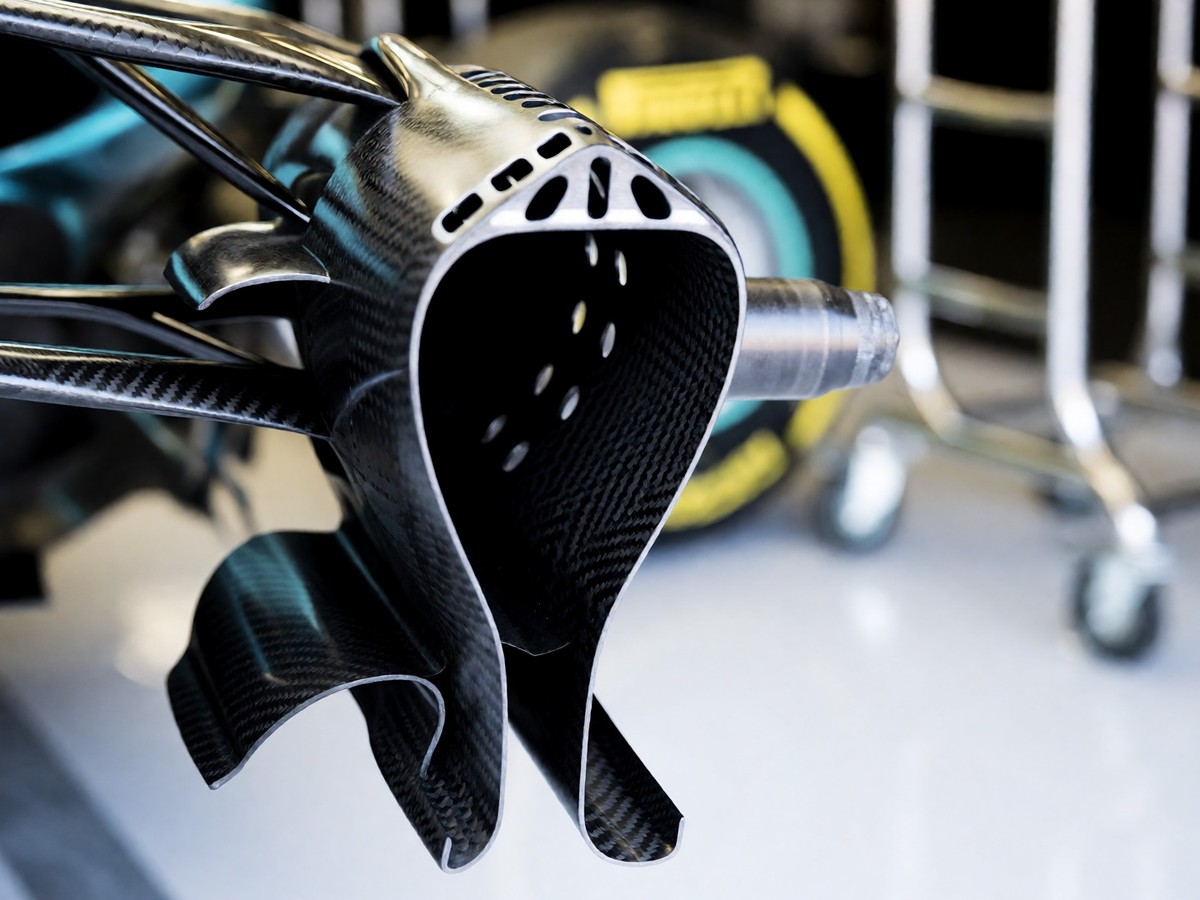
The FIA uses Technical Directives to shut down interpretations of the rules that fall outside the spirit of the regulations. In 2020, Red Bull prompted the FIA to examine the Mercedes brake cooling system. The FIA issued Technical Directive 014/020 before the Melbourne weekend. This directive addressed the brake duct area and its dimensional box. The regulations state the duct must not exceed 160 mm above the wheel horizon. Mercedes used the upper arm of its rear suspension as an inlet to cool the outside of the brake duct. This design managed tire temperatures by reducing heat transfer from the brake to the tire.
This cooling prevented the overheating of Pirelli rubber. The Red Bull team queried the use of an area outside the prescribed box. This area included the triangular intake in the link between the upper wishbone and the brake duct. Mercedes demonstrated that the channels leading from this area did not lead to the brakes. Instead, they channeled air between the drum and the wheel rim. The FIA accepted this for the first three races of 2020 but required a permanent solution later. Mercedes had to modify its cooling system to comply with the directive.
The Racing Point Penalty and Design Responsibility
The FIA penalizes teams that use designs they did not create. Racing Point received a 15-point deduction and a 400,000 Euro fine for its 2020 rear brake ducts. The stewards ruled that the team used Mercedes designs for the RP20. Because brake ducts became "listed parts" in 2020, teams must design them themselves. The stewards concluded that the design effort expended by Racing Point in adapting the rear brake ducts originally designed by Mercedes for the W10 pales in comparison to the significance of the original Mercedes work.
Renault protested the design after the Styrian Grand Prix. The stewards decided the matter was too complex for a single afternoon. They appointed a separate panel of stewards to evaluate the case. The FIA technical department analyzed the similarities between the internal surfaces. The FIA found that Racing Point received CAD models for the 2019 Mercedes rear brake ducts. The team used these models as a starting point for the RP20. The FIA stated that if a team uses data, designs, or drawings from another team to develop its own listed parts, the resulting parts are not its own design.
Enforcement of the Bright-Line Rule
The FIA enforces a "bright-line rule" regarding the use of rival data. Teams cannot use CAD models, drawings, or physical parts from another team to develop their own listed parts. Using such information means the team did not design the part itself. You likely understand that technical loopholes create tension between teams and the governing body. Racing Point admitted they received 2019 Mercedes brake ducts in January 2020. They claimed the parts were for testing to fill a gap. The FIA ruled the transfer did not constitute a significant breach because the rules changed only six days prior.
However, the FIA maintained that the design work violated the sporting regulations. The FIA technical department argued that it does not matter when the parts were designed. The rule applies to the design process itself. The FIA also noted that copying a rival car based on photographs is legitimate. This distinction allows for visual imitation but forbids the use of digital 3D designs or physical components. Guenther Steiner of Haas rejected claims that his team’s brake ducts are illegal. He stated that Ferrari would not sell Haas brake ducts after the rules changed.
Active Aerodynamics and the 2026 Chassis
The 2026 cars feature full-time active aerodynamics. The cars adjust the angle of front and rear wings depending on the circuit. On straights, the flaps move to an "open" position for low drag. In corners, the flaps stay in a "closed" position to maintain downforce. This system aims to reduce turbulence and allow for closer racing. The 2026 chassis is smaller and lighter than the 2025 models. The maximum wheelbase is 3.4m, which is 200mm shorter than previous years. The width of the floor is also reduced to 1.9m.
The weight limit for 2026 is 768kg. This reduction comes from changes to the power units and the chassis dimensions. The Pirelli tyres are also narrower, with a 25mm reduction at the front and a 30mm reduction at the rear. These changes aim to reduce the turbulence-generating out-washing. The cars also feature simplified front wings and in-washing bargeboards. A two-stage nose cone provides protection in heavy impacts. This design offers secondary protection if the car hits a wall after an initial impact.
Soft Power and the Management of Flexi-Wings
The FIA uses "soft power" to manage technical compliance. Instead of waiting for protests, the governing body advises teams to change designs they deem illegal. This approach addressed the rise of flexible aerodynamic components. Teams developed ways to make their rear wings deflect under load to reduce drag on straights. This provided an advantage in cornering speed without the drag penalty on straights. During the 2021 season, the FIA introduced more stringent tests to restrict these designs.
Technical Directive 18 targets components that lack rigidity. This directive addresses Article 3.2.2 of the technical regulations. It requires all aerodynamic components to be immobile with respect to their frame of reference. The FIA found that some teams used elastomeric fillets or thin flexible laminates to allow for localized deflection. These designs allow the wing to deform under specific aerodynamic loads. The FIA instructions require teams to present their wing designs and assembly techniques. This enforcement prevents teams from using materials that only become malleable under certain conditions.
Implications for the 2026 Field
The 2026 regulations change the competitive balance for all 11 teams. The arrival of Cadillac increases the number of cars on the grid to 22. This expansion impacts how Qualifying and Sprint Qualifying sessions run. The elimination process in Q1 and Q2 now removes six cars instead of five. Mercedes supplies engines to four of the 11 teams, including McLaren, Williams, and Alpine. This makes the engine’s legality a massive concern for a large portion of the grid.
The FIA remains proactive to ensure a level playing field. The governing body monitors technical developments closely. The Power Unit Advisory Committee continues to evaluate energy management matters. The FIA intends to ensure that no team benefits from an unnecessary technical advantage. As teams adapt to the 2026 rules, the FIA will continue to issue directives to clarify the intended application of the regulations. Will the new active aero and power unit rules successfully produce the closer racing the FIA expects?