Infrared Monitoring and Thermal Management at Interlagos
New asphalt at Interlagos absorbs significant solar heat, with afternoon temperatures reaching 60C. This thermal challenge impacts tire degradation and grip, requiring advanced TPMS sensors and predictive mathematical modeling to manage performance.

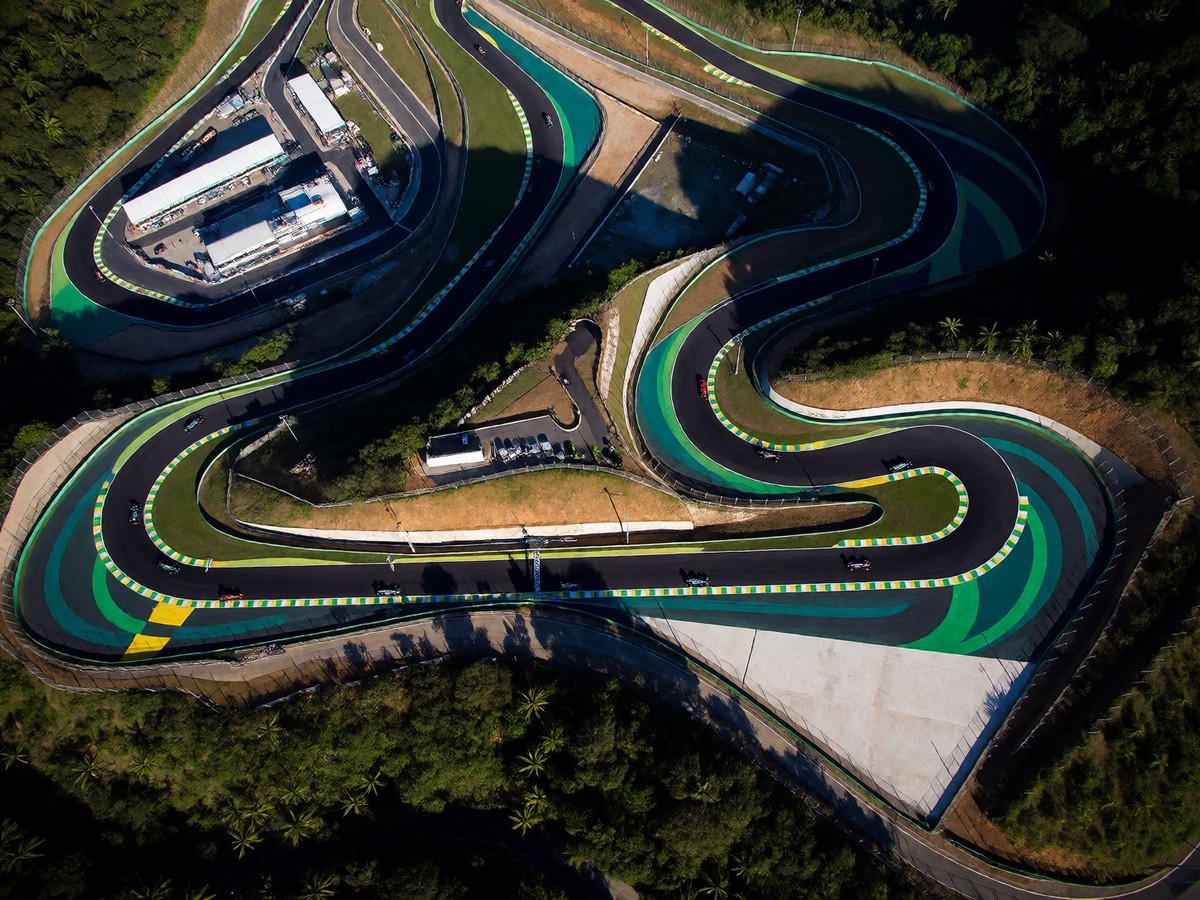
The new asphalt at Interlagos is very black and absorbs the sun’s temperature much more than the old washed-out grey surface used until last year. Early afternoon temperatures on Thursday nudged towards 60C, which creates significant thermal challenges for tire management. Micro-roughness of the surface shows a 46% drop compared to last year, while macro-roughness indicates a 30% drop. These figures suggest the track offers less grip than the previous season. This loss of grip can result in more sliding and therefore higher tire temperatures and more degradation.
The interaction between the chemical adhesion of the track and the tire shows the situation is not drastically different from previous years. Brazil has traditionally not been a venue that offers a lot of grip. Some corners may actually be an improvement compared to before. However, the increased heat from the dark asphalt remains a primary concern for engineers. The higher temperatures could force teams to shift towards harder compounds for both the sprint and the grand prix.
Thermal dynamics and tire stability
Thermal degradation is a major factor for performance because excessive heat causes the rubber’s polymer chains to absorb energy. This energy causes a rupture at the surface, a condition known as blistering. If temperatures are too low, the polymer chains lose thermal energy and become ordered and stiff. This causes sections of the rubber to fall off during the race, which drivers call graining. Higher track temperatures directly impact tire temperatures and amplify any thermal degradation.
Heat also causes internal pressure to rise according to the formula P = nRT. This increase in pressure reduces the contact patch where the rubber touches the track. A smaller contact patch means less grip and forces drivers to slow down. The 2026 regulations aim to manage these extreme conditions through advanced sensor integration. Teams rely on sensors in all four tires to measure rubber temperature, air temperature, and air pressure. These sensors help teams keep tires at the perfect temperature to prevent grip loss or rapid degradation.
Sensor technology and installation
The FIA TPMS equipment includes a wheel sensing unit that transmits data wirelessly to a remote receiver. This unit sends pressure measurements, rim temperature, internal air temperature, and inner carcass temperature. Each sensor has a unique serial number to distinguish readings between individual tires. Inside every TPMS sensor, a pressure cavity tracks changes in air pressure in real time. This sensor uses a microcontroller, an RF transmitter, and a temperature sensor. A tiny battery powers the sensor and lasts between five and ten years. To save power, the sensors sleep when the car is parked and wake up with wheel movement. Sensors transmit new data every 30 to 60 seconds while driving, but they may signal more frequently during rapid changes.
Technicians follow specific steps to replace or install these sensors. First, the technician identifies the vehicle year, make, and model. Second, the way the technician reads existing sensors involves checking the sensor ID, pressure, temperature, battery status, and frequency. Third, the technician programs the new sensor using options like Auto Create, Copy by Activation, or Copy by Input. Fourth, the technician installs the sensor. Fifth, the technician remounts the tire. Sixth, the technician inflates the tire to spec and seats the bead. Seventh, the technician installs the wheel back onto the vehicle and torques the lug nuts to approximately 4 Nm. Finally, the technician performs the relearn procedure.
| Feature | Direct TPMS | Indirect TPMS |
|---|---|---|
| Hardware | Physical sensor in tire | ABS wheel speed sensors |
| Data Source | Pressure transducer | Rotational speed differences |
| Installation | Requires sensor programming | Requires system reset |
Mathematical modeling of degradation
Modern tire degradation analysis uses machine learning and telemetry to predict race outcomes. Advanced predictive models achieve high accuracy, such as a regression R2 of 0.847 and a classification accuracy of 92.3% for degradation categories. Teams use over 50 tire performance indicators, including temperature gradients and pressure variations. These indicators help engineers understand the performance decay throughout a stint. You already know that real-time pressure data changes how teams plan their pit stops.
The Skewed T model performs best in terms of predictive accuracy, beating the base model by nearly a tenth. During the 2025 Austrian Grand Prix, the Skewed T model achieved a root mean squared prediction error of 0.325, while the ARIMA(2,1,2) model recorded 0.613. In stint 2 of that event, when an extreme outlier exists in the positive direction, the Skewed T model shows a 0.316 CRPS while other models range from 0.377 to 0.396. For Lewis Hamilton, the hard compound tires degraded at 0.054 seconds per lap and the medium compound tires at 0.060 seconds per lap.
Strategic compound selection at Interlagos
Pirelli provides three dry weather compounds for the Brazilian Grand Prix: the C2 hard, the C3 medium, and the C4 soft. This selection is one step harder than the compounds used in 2024. The soft compound offers the highest grip but wears out quickly. The hard compound lasts much longer but offers less grip. Drivers receive two sets of hards, three sets of mediums, and eight sets of softs. An extra set of softs is reserved for those who reach Q3.
The 24-lap sprint presents a unique challenge for tire distribution. In the sprint, the medium compound must hold enough for the full distance. If degradation is worse this time, the choice between medium and hard becomes difficult. Because it is a sprint weekend, the allocation includes two sets of hards, four sets of mediums, and six sets of softs. The 2024 soft is not suitable for a race and works only for qualifying. The track is currently cold and green, so the hard compound might not function properly.
Safety systems and wet weather management
The FIA implements several safety measures for wet conditions at Interlagos. Grooves were inserted into the track surface in turns 2, 3, 12, 13, 14, and 15 to help drainage. The apex areas of turns 2 and 12 received resurfacing to manage water accumulation. Organizers also added sausage kerbs behind the apex of existing kerbs at turns 2, 4, 8, and 10. To improve initial grip, the FIA increases tire blanket temperatures for intermediate tires.
A new low-power start detection system identifies cars with abnormally low acceleration shortly after clutch release. In these cases, the system triggers automatic MGU-K deployment to ensure a minimum level of acceleration. An associated visual warning system uses flashing lights on the rear and lateral sides of the car to alert following drivers. The FIA also simplified the rear light systems to provide clearer visual cues in poor conditions. Maximum ERS deployment decreases in wet conditions to limit torque and improve car control. Will the higher track temperatures force teams to shift toward harder compounds more than expected for the sprint?
Power unit and aerodynamic regulations
The 2026 power units rely on electrical energy for significant performance. The electrical side of the power unit deploys 475 bhp under acceleration. The FIA reduced the maximum permitted recharge from 8MJ to 7MJ to reduce excessive harvesting. Peak superclip power is 350kW, which reduces the maximum superclip duration to approximately 2 to 4 seconds per lap. MGU-K deployment is 350kW in key acceleration zones and 250kW in other parts of the lap.
The 2026 regulations also produce smaller and lighter cars. The minimum weight is 724kg, the wheelbase is 340cm, and the width is 190cm. The FIA predicts a 30% reduction in downforce and a 55% reduction in drag. Drivers use active aerodynamics to manage these changes. They switch between Z-mode for downforce and X-mode for low drag. The new rear wings have three elements that open to shed drag, while the front wing has a two-element active flap to balance the car.
Real-time telemetry and strategy
Pirelli uses Cyber Tyre technology to embed sensors in tires to transmit real-time data on pressure, temperature, and wear. This telemetry facilitates data-driven decision-making for racing strategies. The Motor Racing Telematics market integrates 5G and edge computing to enable low latency data exchange. Teams use an off-car receiving system that stores data on a remote server. This system is accessible only to the team with a unique team ID and the FIA.
The ability to analyze data in real time increases the precision of pit stop timing. Teams weigh the 18 to 20 seconds lost during a stop against the performance boost from fresh tires. Strategists analyze cumulative degradation, which is the total lap time loss since the stint began. They also monitor progressive degradation, which tracks the differences in lap times between consecutive laps. The infrared monitoring and TPMS sensors provide the necessary data to manage these variables. The sensor technology is the best tool for navigating the thermal extremes at Interlagos.